
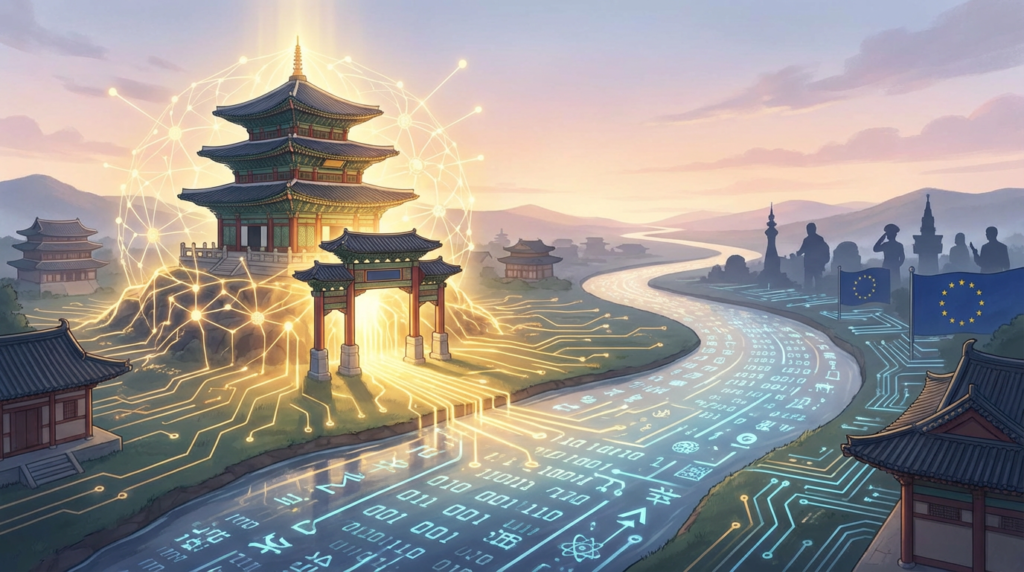
South Korea is preparing to introduce a comprehensive AI framework law that will take effect on January 22, 2026. With this, the country will become the first in the world to implement such extensive AI regulations, ahead of the European Union, whose rules will start being enforced from August 2026.
The Framework Act on the Development of Artificial Intelligence and Establishment of a Trustworthy Foundation, signed in January 2025, mandates the government to establish a national AI committee and develop a three-year plan for the advancement of this technology. The law introduces requirements for safety and transparency, including an obligation to disclose information for selected AI systems. The regulations are based on a risk-based approach, imposing the strictest rules on high-impact systems operating in key sectors such as healthcare, education, and public services.
In December 2025, the Startup Alliance organization conducted a survey among 101 local AI companies. The results showed that only 2% of enterprises had implemented systems enabling compliance with the new regulations. The remaining firms reported serious preparation issues: 48.5% were unaware of the law and unprepared for changes, while another 48.5% were aware of the rules but insufficiently prepared In December 2025, the Startup Alliance organization conducted a survey among 101 local AI companies. The results showed that only 2% of enterprises had implemented systems enabling compliance with the new regulations. The remaining firms reported serious preparation issues: 48.5% were unaware of the law and unprepared for changes, while another 48.5% were aware of the rules but insufficiently prepared[1].
The study revealed that the main obstacles are unclear standards regarding the scope of information duties, the definition of generative AI, and classification criteria for high-impact systems. A representative of the Korea Internet Corporations Association indicated that the executive decree, which will specify the law’s details, will be approved shortly before the regulations come into effect. This leaves companies, especially startups, with very little time to prepare for the changes, which can be overwhelming the executive decree, which will specify the law’s details, will be approved shortly before the regulations come into effect. This leaves companies, especially startups, with very little time to prepare for the changes[4].
Industry experts warn that some companies might be forced to abruptly modify or even suspend their services after January 22. The regulatory pressure is influencing decisions of many Korean AI startups considering relocating their operations to Japan. Japanese authorities have adopted a softer, voluntary approach to AI governance that focuses on promoting innovation instead of strict compliance requirements The regulatory pressure is influencing decisions of many Korean AI startups considering relocating their operations to Japan[5].
One of the most controversial aspects of the law is the mandatory watermarking requirements, which impose obligations to label AI-generated content. The goal is to limit deepfake phenomena and misinformation, but industry representatives argue that the requirements are too vague and could discourage consumers from using AI-created products Mandatory watermarking requirements imposing obligations to label AI-generated content[8].
A representative from an AI content creation company emphasized that even AI-generated materials usually require collaboration among several people to improve quality. Yet consumers might be discouraged if such content is labeled as ‘AI-generated.’ The South Korean government also announced plans in December 2025 to strengthen monitoring of AI-generated advertisements to counter the spread of false information and deepfakes on social media platforms The South Korean government also announced plans in December 2025 to strengthen monitoring of AI-generated advertisements[10].
Despite numerous concerns, the Ministry of Science and ICT introduced a transition period lasting at least one year before administrative penalties for non-compliance with the law are applied. Minister Bae Kyunghoon stressed that the executive decree will become the “institutional foundation for South Korea to become one of the top three global AI powers” Despite numerous concerns, the Ministry of Science and ICT introduced a transition period lasting at least one year before administrative penalties for non-compliance with the law are applied. Minister Bae Kyunghoon stressed that the executive decree will become the “institutional foundation for South Korea to become one of the top three global AI powers”[12].