
I have a confession to make: I don’t have TikTok. Instead, I’ve fallen down a rabbit hole of strange science channels on YouTube. Just before the holidays, I watched a fascinating video about fractals and the Mandelbrot set. These complex, infinite patterns are nature’s mathematical twin—you can zoom in forever, and they continue to generate stunning, self-similar shapes.
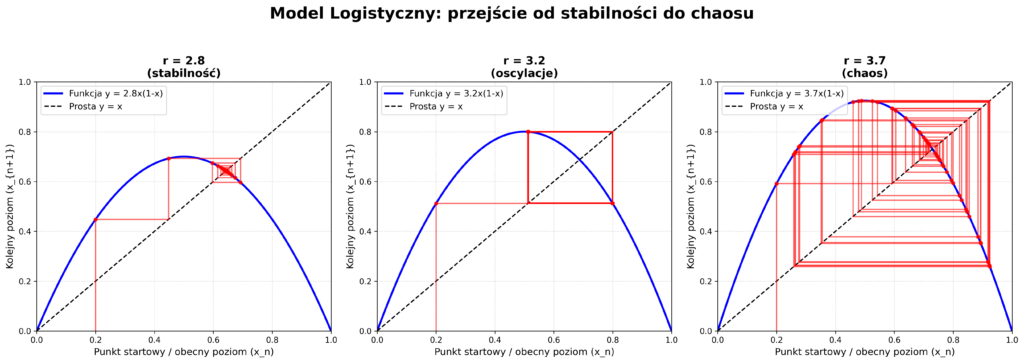
What struck me most was the “edge” of the fractal. The math shows that for certain numbers, their iterations stay “together,” while others rapidly “escape” into infinity. At the boundary, even a tiny change in the starting value leads to a completely different result after a few repetitions. Scientists call this the “Butterfly Effect.”
It got me thinking: is it the same with information and how people perceive brands? Can a tiny shift in communication—especially in how we react to external feedback—trigger a massive crisis, a viral hype, or perhaps no reaction at all?
Communication is a Dynamic System, Not a Straight Line
Traditional PR often treats communication as a linear path: sender → message → receiver. In reality, modern communication functions as an open, non-linear dynamic system. It is a sequence of iterations: your message → market reaction → competitor response → regulator move → your next reply.
Research shows that even simple systems with feedback loops can spontaneously shift from stability to total chaos without a single, massive “trigger”. You don’t need a “big mistake”—an accumulation of small stimuli in a highly sensitive system is enough.
The Three States of Your Narrative
Just like physical systems, a brand’s communication environment exists in one of three states:
Stability: Audience reactions fade out, leading to a single dominant interpretation. The market “agrees” with your narrative.
Oscillations (Dispute): The system jumps between two or more competing narratives. This is common in polarized topics like ESG or regulations. While it looks like a “normal” debate, the system is unstable and can tip into chaos with a small nudge.
- Information Chaos: Reactions become unpredictable. Facts lose their meaning, and the narrative fragments into memes and misinformation. Traditional PR tools like “appeals to reason” often fail or even backfire here.
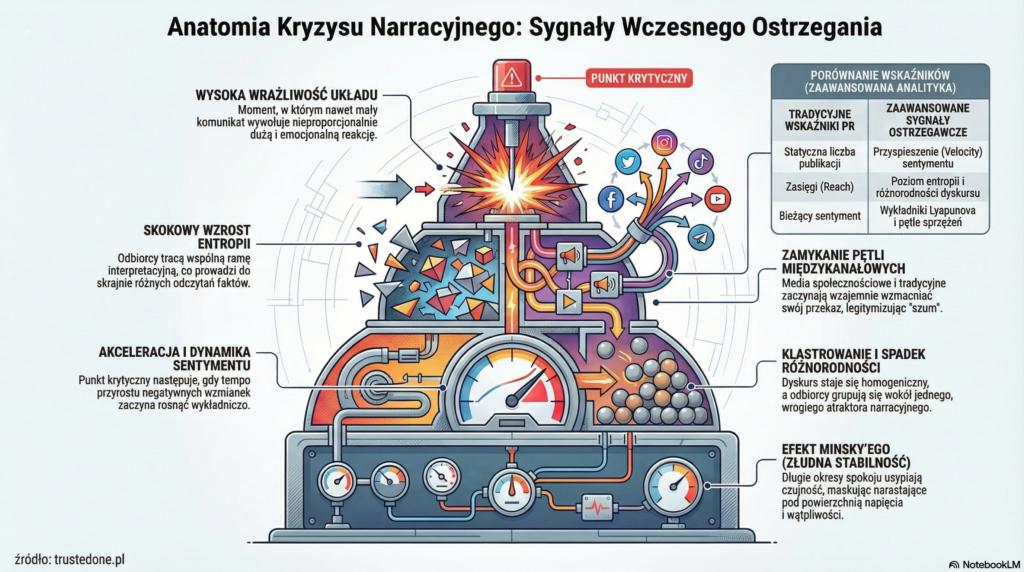
The “Minsky Moment”: Why Stability Breeds Instability
We often think that a long period of quiet means we are safe. However, economist Hyman Minsky (1992) noted that “stability is destabilizing”. Prolonged calm can lull us into a false sense of security while hidden tensions accumulate. A topic that seems “settled” can suddenly become highly volatile at the slightest provocation.
Monitoring the “Temperature,” Not Just the Volume
To stay ahead, we need to measure more than just reach or the number of mentions. We need to track the dynamics:
NSI (Narrative Stability Index): Does the audience reaction settle down or keep shifting?
PI (Polarization Index): Is the conversation converging or splitting into opposing camps?
DRI (Dynamics Reaction Index): How much is the reaction “feeding itself”?
Operational Takeaways
When a crisis looms, the priority is to slow the system down and introduce “negative feedback” to cool emotions:
Lower the Amplitude: Tone is a stability parameter, not just an aesthetic choice. Avoid aggressive defense, which creates “positive feedback” loops that escalate the crisis.
Act Early: False narratives spread 70% faster than the truth. Early intervention based on facts can break an information cascade before it hardens.
- Simplify: In chaos, move to a single, dominant message and limit the number of sources to regain control.
Effective communication today isn’t about a “strong message”; it’s about maintaining the stability of the entire process.
Related posts:
- Does your text really resonate with people? This is how I use AI to study comprehensibility and resonance.
- Greenwashing 2025: When Green Promises End Up in Court (and How to Avoid It)
- 70% planning, 30% code – what working with AI actually looks like
- Weekly AI Review: Gemini 3 Pro Dominance, $20B Megafunding for xAI, and New California Regulations