
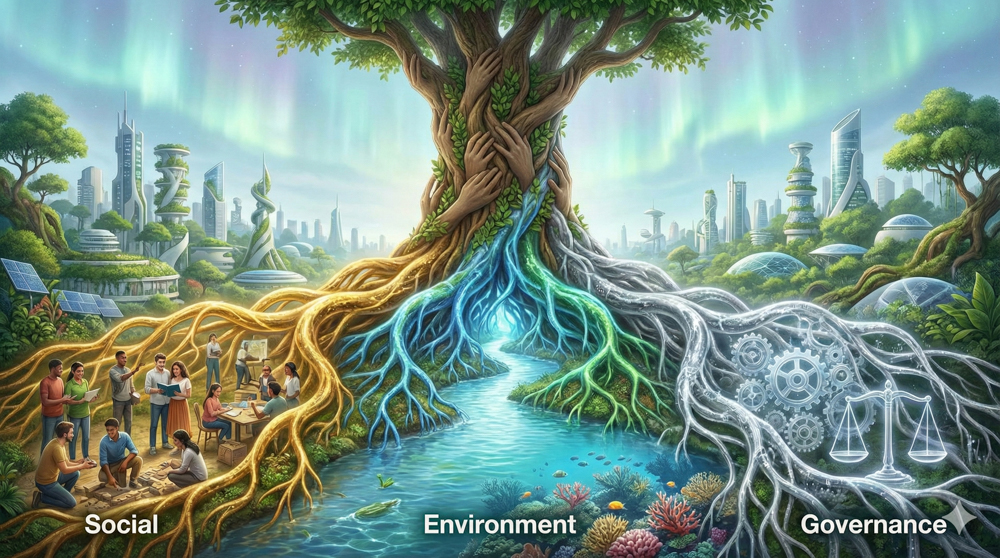
On February 24, 2026, The EU Council approved the Omnibus I directive[2], concluding a year-long process of simplifying the Union’s sustainability regulations. The new council rules drastically raise the thresholds for inclusion under the CSRD to 1,000 employees and 450 million euros in net annual turnover, and for the CSDDD to 1.5 billion euros turnover within the European Union. According to estimates from the law firm Ropes & Gray, about 90% of companies originally planned under CSRD are excluded, and around 70% from CSDDD. The next wave of non-financial reporting will cover the 2027 fiscal year (reports in 2028), with audit assurance levels permanently set at “limited assurance,” without advancing to “reasonable assurance.” The obligation for legally required climate transition plans at the EU-wide level has also been removed from CSDDD.
Omnibus I Limits CSRD and CSDDD
However, the formal narrowing of regulatory scope does not exempt many large companies in Poland from pressure by investors, banks, and customers, who increasingly demand data comparable to CSRD. The new, simplified ESRS standards reduce the number of mandatory data points[4] by about 61%, shifting the focus from mechanical reporting to qualitative narrative, solid materiality analysis, and compatibility with international ISSB standards. For the services market, this means a lower volume of mandatorily audited reports in the short term, but greater demand for consulting on data systems, materiality assessments, and building coherent disclosure packages across multiple jurisdictions.
Polish Energy Sector: More Renewables and Storage
In Poland, the Ministry of Climate and Environment confirmed that by the end of 2025, renewable energy sources accounted for 50.04% of installed system capacity — 37,777 MW out of a total of 75,496.3 MW. Photovoltaic power reached between 24.8 and 25.5 GW[7], while wind power exceeded 10.5 GW. Renewable energy production amounted to about 55 TWh, or 31.4% of the national electricity production, with a record growth of approximately 3.6 GW of new PV capacity in 2025. Data from ENTSO-E and the Renewable Energy Institute show[8] that in 2025, over 1 TWh of wind and solar energy failed to reach the grid due to curtailment, increasing investment risks and impacting wholesale prices.
Amid the growing share of renewables, a support package for energy storage stands out. R. Power signed agreements with the National Fund for Environmental Protection and Water Management for grants from the Modernization Fund totaling 499.1 million PLN (about 139 million USD) to develop large BESS installations. The NFOŚiGW program plans the construction of 172 energy storage units[10] with a combined capacity close to 3.9 GW by 2028. Additionally, Bank Millennium granted R. Power a project loan of 181 million PLN for a portfolio of 70.5 MWp of photovoltaic farms across nine locations, secured by CfD and PPA contracts covering about 470 GWh of energy. Overall, the developer has already contracted roughly 6.3 GWh of storage capacity on the capacity market in auctions for 2024–2025.
Greenwashing Under Scrutiny and Global Climate Disputes
At the same time, The Office of Competition and Consumer Protection initiated high-profile proceedings[9] against the platform Bolt, the company Tchibo, and the Zara chain over suspected greenwashing. The regulator challenged claims about “zero-emission” vehicles, declarations of “100% renewable energy” mostly based on certificates, as well as labels like “eco,” “sustainable,” “Join Life,” “zero waste,” or “zero net emissions” without a clear definition of scope and data basis. Companies face fines up to 10% of annual turnover for each misleading practice. These cases fit into a broader line of UOKiK actions against pseudo-ecological marketing, after previous proceedings against Allegro, DHL, DPD, and others.
Globally, legal disputes around climate policies and net-zero communication are also mounting. On February 12, 2026, the Environmental Protection Agency in the US repealed the so-called endangerment finding from 2009, which recognized greenhouse gases as a threat to human health and welfare, and withdrew federal CO₂ emission standards for vehicles. The White House estimates declared regulatory savings at around 1.3 trillion dollars, but coalitions such as the Union of Concerned Scientists and Earthjustice have already challenged this decision. In Australia, the Federal Court in Australasian Centre for Corporate Responsibility v Santos Ltd dismissed[5] greenwashing claims regarding terms like “clean energy,” “clean fuel,” and “zero-emissions hydrogen,” emphasizing the need to demonstrate “reasonable grounds” for net-zero plans[6] and accurately present the role of CCS technology and offsets. Meanwhile, A new study published in ‘Geophysical Research Letters’ estimates[1] with 54% probability that weather disaster damages in the US will exceed 1 trillion dollars between 2026 and 2030, increasing pressure on insurers, banks, and regulators worldwide. On financial markets, S&P Global Ratings forecasts the value of outstanding sustainable debt[3] will reach about 5.5 trillion dollars in 2026, and according to the green debt market has surpassed the 3 trillion dollar mark, despite a decline in new issuances to 866 billion dollars in 2025 (down 19% year on year).
Sources
Related posts:
- Freight Signals at the Start of 2026: Cheap Sea Freight, Suez Returns, Record Investments in Poland
- Pensions, Insurance, and Interest Rates in 2026: What Awaits Seniors in Poland and the USA
- ESG at a Crossroads: CBAM, Simplified Reporting, and Real Costs of the Climate Crisis
- ESG Regulations Under Pressure: Cuts in Europe, Legal Offensive in the US and UK