
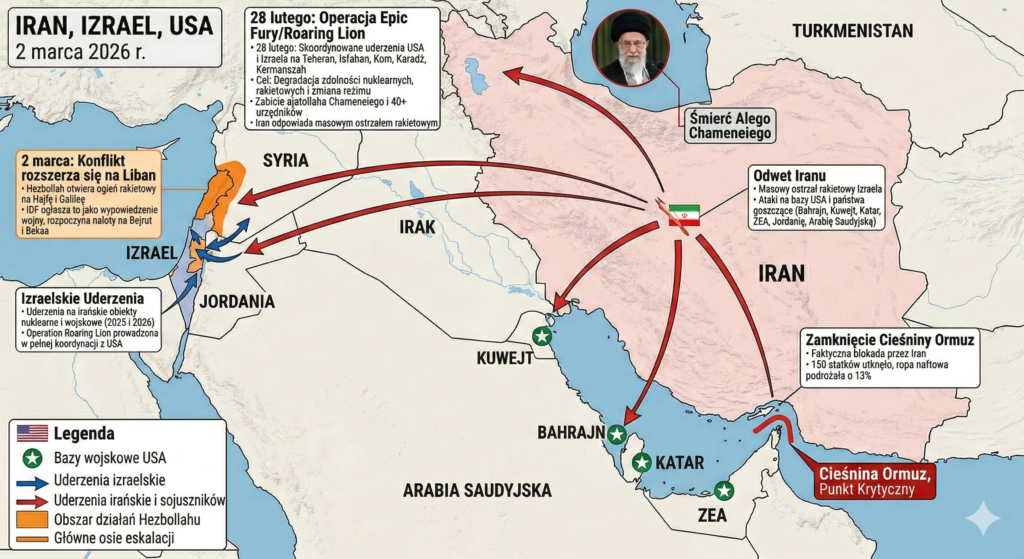
Situation Summary
On February 28, 2026, the United States and Israel launched a coordinated military operation against Iran—codenamed Operation Epic Fury (USA) and Operation Roaring Lion (Israel). The strikes resulted in the death of Iran’s Supreme Leader, Ayatollah Ali Khamenei, and over 40 high-ranking officials of the Iranian regime. Iran responded with massive missile and drone strikes against Israel, U.S. bases in the Persian Gulf region, and their host nations—Bahrain, Kuwait, Qatar, the UAE, Jordan, and Saudi Arabia. On March 2, 2026, the conflict expanded to Lebanon as Hezbollah joined the hostilities against Israel. [1][2][3][4][5][6]
This marks the second direct armed confrontation between these parties in just eight months, following the 12-day war in June 2025. [7]
Timeline of Key Events
2024: Escalation of Proxy Conflict
| Date | Event |
| April 2024 | The first direct exchange of missiles between Iran and Israel in the 45-year history of the Islamic Republic. [8] |
| October 2024 | Another exchange of strikes; Israel hits the Taleghan 2 facility at the Parchin military complex, linked to the nuclear weapons program. [9] |
2025: The 12-Day War and Its Aftermath
| Date | Event |
| January 2025 | Trump returns to the White House; asks Israel to hold off on attacks in favor of diplomacy. [7] |
| May 16 | Trump sends a nuclear proposal to Iran; Khamenei rejects it, calling the demands “excessive and outrageous.” [10] |
| June 9 | Iran formally rejects the American proposal for a nuclear agreement. [10] |
| June 13 | Israel carries out a surprise attack on Iranian nuclear and military facilities (Tehran, Fordow, Natanz)—beginning of the 12-Day War. Iran responds with massive missile strikes on Israeli cities. [11][12] |
| June 19 | An Iranian Sejjil ballistic missile hits Soroka Hospital in Beersheba; 71 wounded. [11] |
| June 21–22 | The USA joins the war—Operation Midnight Hammer: strikes on Fordow, Natanz, and Isfahan using bunker-buster bombs and cruise missiles. [11][8] |
| June 23 | Iran attacks the U.S. Al Udeid base in Qatar (no casualties); Israel strikes Tehran again. [11][12] |
| June 24 | Ceasefire announced by Trump. Iran reports 610+ killed (government) / 1,190 (HRANA). Israel: 28 killed, 3,238 wounded. [12][13] |
| Summer–Autumn 2025 | Satellite imagery shows Iranian attempts to rebuild nuclear facilities (Taleghan 2, Natanz). [9] |
| November 2025 | Israeli expert Raz Zimmt from INSS warns: “The next round will be worse; Israel will strike more than just nuclear facilities.” [14] |
| December 2025 | Following Netanyahu’s visit to the USA, Trump threatens Iran again. At the end of the month, mass protests break out in Iran (Rial crisis, inflation). [12][7] |
2026: Escalation and New War
| Date | Event |
| January 8–9 | Mass massacres of protesters in Iran—casualty estimates: 3,117 (Iranian government), ~7,000 (HRANA), up to 36,500 (Iran International). [15][16][17] |
| January 13 | Trump tells Iranians: “Help is on the way.” [12] |
| January 23 | Trump announces the deployment of an “armada” to the Middle East: aircraft carriers USS Abraham Lincoln and USS Gerald R. Ford. [3] |
| February 6 | Indirect nuclear talks between the USA and Iran in Muscat (Oman). [3] |
| February 13 | Trump: Regime change in Iran is the “best thing that could happen.” [18][19] |
| February 14 | Reuters sources: U.S. military prepares for weeks of operations covering Iran’s state and security infrastructure. [20] |
| February 19 | Largest buildup of U.S. military presence in the Middle East since the 2003 invasion of Iraq. [3] |
| February 24 | Trump’s State of the Union address—accuses Iran of reviving its nuclear program and missile development. [3] |
| February 26–27 | Round III of talks in Geneva—”most intense negotiations.” Oman announces a “breakthrough”—Iran reportedly agreed to dilute uranium stockpiles. [21][22] Simultaneously, an IAEA report reveals Iran hid highly enriched uranium in an undamaged underground facility. [3] |
| February 28, ~9:45 AM (Iran Time) | Start of Operation Epic Fury / Roaring Lion—coordinated U.S.–Israeli strike on Tehran, Isfahan, Qom, Karaj, and Kermanshah. [3] |
| February 28 | Killing of Ayatollah Khamenei and 40+ Iranian officials (including Shamkhani, Nasirzadeh, Pakpur, Musawi). [4][23][6] |
| February 28 | Iran responds with massive missile strikes on Israel, U.S. bases, and Gulf states. Strait of Hormuz effectively closed. [2][5] |
| February 28 | Israel declares a state of emergency, closes schools and workplaces. [24] |
| March 1 | Confirmation of the deaths of three U.S. soldiers at Camp Arifjan (Kuwait). [25][26] An Iranian missile hits a synagogue in Beit Shemesh—9 killed. [3] A raid on a girls’ school in Minab—according to Iran, 148 students killed. [27] |
| March 1 | Iran establishes a temporary Leadership Council (President + Head of Judiciary + Cleric). [6][28] |
| March 1 | Trump declares readiness for negotiations; Iran (Larijani) refuses talks. [3] |
| March 2 | Hezbollah opens fire with rockets from Lebanon toward Haifa and Galilee. The IDF declares this an “act of war” and begins airstrikes on Beirut, Bekaa, and southern Lebanon. [1][2] |
What We Know for Certain
Ayatollah Ali Khamenei is dead—confirmed by both Iranian state media and the U.S.–Israeli side. [4][29]
Over 40 high-ranking Iranian officials were killed, including National Security Council chief Ali Shamkhani, Defense Minister Aziz Nasirzadeh, IRGC commander Mohammad Pakpur, Chief of Staff Abdolrahim Musawi, and former president Mahmoud Ahmadinejad. [3][6]
Iran carried out retaliation by striking Israel, U.S. bases in six countries, and civilian targets in the Persian Gulf (including airports in Kuwait and the UAE, and hotels in Bahrain and Dubai) with missiles and drones. [2][5][3]
Three American soldiers were killed, five are seriously wounded. [25][26]
The Strait of Hormuz is effectively closed—150 ships are stranded, oil prices rose by 13% (Brent to $82 USD/bbl). [30][31]
The conflict expanded to Lebanon—Hezbollah attacked Israel, and the IDF responded with airstrikes on Beirut. [1][2]
In January 2026, the Iranian regime committed mass massacres against protesters—according to the government, 3,117 people died, but independent sources provide much higher numbers. [15][16]
What We Assume, But Lack Certainty
Did Iran actually resume its military nuclear program? The Trump administration repeatedly claimed Iran was “a week away from bomb-grade material.” However, American and European intelligence agencies, as well as the IAEA, questioned these claims. The Pentagon estimated that after the June 2025 strikes, the Iranian program was delayed by 1–2 years. The IAEA stated on February 27, 2026, that it could not verify whether Iran had halted all enrichment activities. [22][32][3]
Is regime change a realistic scenario? Trump and Netanyahu openly call for Iranians to overthrow the government, but military experts (e.g., Michael Mulroy, former U.S. Deputy Assistant Secretary of Defense) warn that “regime change cannot be achieved through airstrikes alone.” The CFR outlined three scenarios: continuation of the regime, military takeover (IRGC), or collapse—but concluded that “change at the top alone is not enough to topple the system.” [33][34]
The true scale of civilian casualties. On the Iranian side, the Red Crescent reported 201 dead and 747 wounded by the end of the first day, but the situation is rapidly evolving. The strike on the school in Minab—148 victims according to Iran—has not been independently confirmed, though the Washington Post and NYT verified the footage. [27][3]
Iran’s ability to sustain retaliation. RUSI experts estimate that Iran has 1,500–3,000 ballistic missiles, but they are being depleted quickly (170 launched on the first day). Iran’s regional allies (Hezbollah, Houthis) were significantly weakened previously. [35]
What We Do Not Know
How long the conflict will last. Trump spoke of 4 weeks, but analysts question the reality of this schedule. [3]
Whether a ground intervention will occur. So far, the operation relies on air and missile strikes—there is no information regarding landing plans. [36]
Who will succeed Khamenei. Secretary of State Rubio admitted in January that “no one knows” who will take power. The CIA assesses that a hardline leader from the IRGC is a likely successor. [29][33]
Whether Russia or China will intervene militarily. So far, their reactions have been limited to rhetoric—CNA analysts point out that in June 2025, Iranian officials “expressed frustration at Moscow’s inaction.” [37]
The long-term economic consequences. Goldman Sachs warns that a month-long closure of the Strait of Hormuz could double gas prices in Europe. Maersk has suspended operations in both the Hormuz and the Suez Canal. [31][30]
Whether Iran possesses hidden stockpiles of highly enriched uranium. The IAEA report from February 27, 2026, revealed that Iran hid material in a previously undamaged underground facility, but the full picture is unknown. [22][3]
Official Government Positions
United States
The Trump administration evolved from diplomacy to an open pursuit of regime change:
January 2025: Trump asks Israel to hold off on attacks, favoring negotiations. [7]
June 2025: After Iran rejects the nuclear proposal, the USA joins Israel’s war with Iran. Trump announces that Iran’s nuclear program has been “completely and totally destroyed”—a claim questioned by experts. [32][36]
January 2026: Following massacres of protesters, Trump says “help is on the way” and sends the fleet. [12]
February 2026: Trump openly supports regime change—”the best thing that could happen.” In the State of the Union address, he accuses Iran of reviving its nuclear program. [18][3]
February 28, 2026: In an 8-minute video message, Trump announces the goal: “to defend the American people by eliminating direct threats from the Iranian regime.” He calls on IRGC guards to lay down their arms in exchange for “full immunity” and the Iranian people to take power: “This is probably your only chance for generations.” [36][3]
Israel
Before the attack: Netanyahu campaigned for years against the Iranian nuclear program. On February 19, 2026, he warned Iran of an “unimaginable” response in the event of an attack. [38]
February 28, 2026: Netanyahu announces Operation Roaring Lion—”the end of the threat from the regime of the ayatollahs.” He distinguishes between the “murderous regime” and the “great Iranian people.” He draws a parallel to Purim—the holiday story of saving Jews from a Persian threat. [39]
Key message: The operation is conducted in “full coordination” with the USA under “Trump’s courageous leadership.” The goal is to degrade nuclear and missile capabilities and create conditions for the Iranian people to overthrow the regime. [39]
Iran
Iran’s position changed dramatically after the killing of Khamenei:
Before the attack: Iran claimed its nuclear program was peaceful, citing Khamenei’s fatwa banning nuclear weapons. Simultaneously, advisor Kamal Kharrazi admitted Iran has the “technical capability” to build a nuclear weapon but is restricted by the fatwa. [10]
In negotiations: Iran rejected the demand for zero enrichment and demanded the lifting of sanctions. It was ready for “minimal enrichment” under IAEA supervision but did not agree to the destruction of infrastructure or sending uranium to the USA. [21][40]
After the attack: Ali Larijani announced a temporary Leadership Council and accused the USA and Israel of attempting to “dismantle Iran.” The IRGC promised “the most devastating offensive operation in the history of the Islamic Republic.” Parliament Speaker Qalibaf threatened: “You have crossed our red line and you must pay for it.” Larijani rejected Trump’s offer for further negotiations. [6][41][42][3]
Russia
Condemned the attacks as a “planned and unprovoked act of armed aggression” violating “fundamental principles of international law.” [43][44]
Putin called the killing of Khamenei a “cynical murder.” [45]
Medvedev: “The USA used negotiations as a pretext to justify military action.” [43]
Lavrov spoke by phone with the Iranian MFA and offered mediation at the UN. [43]
However: Both in June 2025 and now, Russia has limited itself to rhetoric—no concrete military aid. Iranian officials already “expressed frustration at Moscow’s perceived inaction” after the 12-Day War. [37]
China
Expressed “deep concern” and called for an “immediate cessation of military actions.” [46][43]
The MFA called the killing of Khamenei a “serious violation of Iran’s sovereignty and UN Charter principles.” [45]
Characteristic: China avoided the word “condemn” in initial reactions, using more balanced language than Russia. [46]
China is evacuating its citizens from Iran by land. [1]
Context: China is the primary buyer of Iranian oil (1–1.5 million barrels/day)—the closure of Hormuz is a major economic problem for them. [31]
European Union and Europe
E3 (UK, France, Germany): Joint statement: they did not participate in the attacks but “strongly condemn Iranian attacks on countries in the region.” They call on Iran to seek a “negotiated solution.” [47][48]
France (Macron): Called for a UN Security Council meeting. Described the escalation as “dangerous for everyone.” [48]
Spain (Sánchez): Rejected the “unilateral military action of the USA and Israel”—one of the strongest voices in the EU. [48]
EU (Kallas, von der Leyen): Called for “maximum restraint” and “full respect for international law.” [49]
March 1—change of tone: The E3 declares readiness to support “proportional military defensive measures”—signaling potential direct intervention. Starmer allowed the USA to use British bases for “defensive strikes.” [3]
Europe’s dilemma: EU leaders oppose the Iranian nuclear program and repressions but are reluctant to accept Trump’s unilateral military action, which may violate international law. [48]
Persian Gulf States
The position of the Gulf states has changed radically compared to June 2025:
June 2025: GCC countries condemned Israel’s attacks and expressed “regret” over American strikes. Qatar expressed “regret over the attacks on the sisterly Islamic Republic of Iran.” They denied the USA access to their airspace. [50][51]
February 2026: After Iran struck their territory—unanimous condemnation of “flagrant Iranian aggression” and “violation of sovereignty.” Saudi Arabia declared “readiness to put all capabilities” at the region’s disposal. MBS and MBZ held their first conversation in weeks, putting aside disputes over Yemen. [52][50]
Oman—the only GCC country not attacked—traditionally plays the role of mediator. [53]
Expert and Analyst Opinions
⚠️ Note: The following positions are opinions of commentators, not verified facts. They are included for a more complete picture of the debate.
On Regime Change Prospects
Michael Mulroy (former U.S. Deputy Assistant Secretary of Defense, Al Jazeera): “Regime change cannot be achieved through airstrikes alone. If there are still survivors who can speak—the regime continues.” [34]
New Lines Institute (Washington): “A tactical victory is within reach for the USA and Israel, but without a strategic plan for ‘the day after,’ there is a risk of open conflict with no visible end. Israel may achieve degradation of Iranian capabilities, but when oil markets react, proxy networks respond, and reconstruction costs accumulate—the geopolitical burden will fall on Washington.” [54]
CFR: Changing the leader in Iran could take three forms—continuation of the system, military takeover (IRGC), or collapse—but “change at the top alone is not enough to topple the system.” [33]
Al Jazeera: Analysts warn that a power vacuum might give birth not to a democratic Iran, but a “garrison state”—a militarized regime fighting for survival without any political constraints. [34]
On Iranian Retaliation Potential
Matthew Savill (Royal United Services Institute, RUSI): “The USA and Israel are focused on destroying Iranian military capabilities and leadership.” The question is whether the Iranian regime can survive while inflicting enough damage in the region. [35]
Jonathan Hackett (author of a book on Iran’s secret war): Iran has 1,500–3,000 ballistic missiles of varying ranges, but they are being depleted quickly. [35]
ISW/CTP: “The inconsistency of Iranian retaliatory attacks on March 1 suggests that Iranian units may be struggling to coordinate large-scale attacks.” [26]
On Economic Implications
Jorge León (Rystad Energy): “The most immediate effect is the effective halt of traffic through the Strait of Hormuz, blocking 15 million barrels of oil per day. If de-escalation signals do not appear quickly, we expect a significant upward price correction.” [30]
Goldman Sachs: A month-long closure of Hormuz could double gas prices in Europe and Asia (to ~$25 USD/MMBtu). Longer blockades could exceed 100 EUR/MWh, triggering demand destruction. [31]
Ali Vaez (International Crisis Group): “Closing Hormuz would disrupt about one-fifth of the world’s oil trade overnight—prices wouldn’t just soar, they would shock the markets, driven by fear alone.” [55]
On the Position of Russia and China
Prof. Radosław Fiedler (UAM, interview with PAP): Russia and China are interested in maintaining the current regime in Iran—”the loss of Iran is a major geopolitical problem, especially for Russia, which has already lost influence in Syria and the Caucasus.” [56]
CNA (after the 12-Day War): “Relatively subdued reactions from China and Russia reflect divergent interests they are trying to balance. Iranian officials expressed frustration at Moscow’s and Beijing’s inaction.” [37]
Polish Expert Voices
Dr hab. Robert Czulda (prof. UŁ, June 2025): “The Iranian strike on Qatar was purely symbolic—zero destruction, zero dead. But I would be cautious about the truce, as various words are being said and there are reports of its violation.” [57]
Łukasz Przybyszewski (Iran specialist, WP, June 2025): Warned that killing Khamenei “could paradoxically strengthen the unity of Iranian elites—it risks a symbolic mobilization of society around the flag and the regime.” He pointed out that “anyone who steps into the predecessor’s place will be a target” of Israel’s leadership decapitation campaign. [58]
Fact vs. Assumption: Certainty Matrix
The following matrix categorizes information by its level of credibility—from facts confirmed by multiple independent sources to disputed claims and completely unknown issues.
Hard Facts (Confirmed by multiple sources)
| Fact | Confirming Sources |
| Ali Khamenei was killed on Feb 28, 2026. | Iranian state media (Fars News), Trump, Netanyahu, CNN, Reuters [4][29] |
| Over 40 high-ranking Iranian officials were killed. | IDF, Iranian media, CBS News, Reuters [3][6] |
| The operation was coordinated by the USA and Israel. | Confirmed by both sides simultaneously [7][3] |
| Iran carried out retaliation against Israel and U.S. bases in 6 countries. | Confirmed by attacked states (Bahrain, Kuwait, Qatar, UAE, Jordan, Saudi Arabia) [52][5] |
| Three American soldiers died at Camp Arifjan (Kuwait). | CENTCOM, Trump [25][26] |
| The Strait of Hormuz is effectively closed / severely disrupted. | Reuters, Operation Aspides, ship tracking data, Maersk suspended operations [30][31] |
| Hezbollah attacked Israel from Lebanon on March 2. | IDF, Hezbollah (confirmation of responsibility), sirens in Haifa [1][2] |
| The Iranian government committed mass massacres of protesters in Jan 2026. | Iranian government (3,117 dead), HRANA, BBC News Persian, Iran International, UN [15][16][59] |
Disputed Claims (Different sources provide conflicting information)
| Claim | Who claims | Who questions |
| “Iran resumed the nuclear weapons program and is a week from bomb material.” | Trump envoy Steve Witkoff, White House [32] | American and European intelligence agencies, IAEA (cannot verify), international arms control organizations. Pentagon estimated 1–2 year delay [3][22] |
| True scale of protester massacre (Jan 2026). | Iranian gov: 3,117 dead. HRANA: ~7,000 verified. Iran International: 36,500. Trump: 32,000 [15][16][17] | Data is discrepant by orders of magnitude—lack of independent verification due to internet blackout in Iran |
| “Nuclear program was completely destroyed” after June 2025. | Trump repeatedly claimed the program was “obliterated” [32][36] | IAEA: Iran could resume enrichment “within a few months.” FDD: Iran actively rebuilding. Concrete sarcophagus built at Taleghan 2 [9][32] |
| Raid on girls’ school in Minab—148 victims. | Iranian state media, Iran MFA [27] | Lack of independent confirmation of casualty numbers; WP and NYT verified only footage from the scene [3] |
| “Iran planned a preemptive missile attack” (pretext for operation). | Anonymous American source cited by media [3] | Lack of public proof; RUSI stated “there was no evidence of an imminent Iranian attack” [3] |
| Oman announced a “breakthrough” in nuclear talks on Feb 27. | Oman MFA (Iran agreed to dilute uranium) [21] | Attack occurred the next day—question of whether negotiations were conducted in good faith by both sides |
Unknown Issues (No source provides a credible answer)
Who will succeed Khamenei? Rubio admitted: “no one knows.” CIA estimates a hardline leader from the IRGC. Possible candidate: Hassan Khomeini (grandson of the founder). [29][33]
Will there be a U.S. ground intervention? No official source confirms or excludes this. Trump speaks of 4 weeks of operation. [36][3]
Will Russia or China intervene militarily? So far, rhetoric without action. Lack of mutual defense clauses in their pacts with Iran. [37]
Does Iran possess hidden stockpiles of highly enriched uranium? IAEA revealed the existence of hidden material on Feb 27, but the full picture is unknown. [22][3]
How long will the closure of the Strait of Hormuz last? Depends on the course of the conflict. 150 ships are stranded, but some still attempt passage. [30]
Full scale of civilian casualties in Iran. Internet blackout (4% of normal connectivity) prevents independent verification. [3]
Predicted Effects and Scenarios
Military Scenarios
Analysts identify four main paths for the further development of the conflict: [60]
| Scenario | Description | Probability (Expert assessment) |
| Limited war + negotiated pauses | Short, intense military exchanges to restore deterrence, followed by quiet diplomacy via Gulf states | Less likely after Khamenei’s killing—Iran rejected talks [3] |
| Prolonged shadow war | Cyberattacks, proxy strikes, secret operations, maritime disruptions without formal declaration of war | Possible as a later phase if both sides reach a stalemate |
| Full-scale regional war | Hezbollah full front from Lebanon, Houthis from Yemen, direct attacks on U.S. forces, Hormuz paralysis for weeks/months | Most dangerous scenario—first symptoms appeared on March 2 (Hezbollah, attacks on Cyprus) [1][2] |
| Strategic reset | Escalation leads to exhaustion, forcing a renewal of diplomacy and new regional security agreements | Long-term possible, but requires political change in Iran |
Key military threats:
Depletion of the Iranian arsenal. Iran launched 170 missiles on the first day; experts estimate the total arsenal at 1,500–3,000 units. ISW notes growing “inconsistency” in retaliatory attacks, suggesting coordination problems. [26][35]
Multi-front nature. Besides the main Iranian front, active ones include: Hezbollah (Lebanon), Houthis (Red Sea), militias in Iraq. However, these groups were significantly weakened in 2024–2025. [61][35]
Risk of attack on oil infrastructure. Israeli expert Zimmt warned as early as Nov 2025 that the next round would include not only nuclear facilities but also oil installations. [14]
Strikes on UK bases. An Iranian drone hit the RAF Akrotiri base in Cyprus—the first direct strike on a British facility, expanding the circle of conflict parties. [3]
Political Scenarios
Analysts draw three main trajectories for Iran’s future after Khamenei’s death:
1. Continuation of the system under a new face (most likely according to CFR) [33]
The IRGC pushes for the swift appointment of a new Supreme Leader.
The system survives but becomes more militarized—experts warn of a “garrison state.” [34]
Karim Sadjadpour (Carnegie): “If the regime falls, the authoritarian alternative is better prepared to take power than the democratic one.” [61]
Expert consensus: probability of regime survival approx. 70–75%. [61]
2. Elite fracturation and semi-controlled transition (likely, high impact)
IRGC factions conclude that the status quo is unsustainable.
Possible limited reform or personnel change while maintaining institutions. [62][63]
Possible candidate: Hassan Khomeini (grandson of the Islamic Republic’s founder)—could serve as the “face of reform.” [33]
3. Regime collapse / civil war (less likely, catastrophic)
Requires several simultaneous shocks: decapitation of IRGC leadership + inability to pay security forces + mass desertions. [61]
Iran is not a fragile state like Syria—93 million people, strong coercive apparatus, Persian nationalism as a glue. [64][61]
Main risk: not a popular uprising, but elite fracturation—competing IRGC factions reaching for weapons. [61]
Michael Rubin (AEI) warned that in a collapse scenario, Azerbaijan, Turkey, and Saudi Arabia might intervene—making Iran an “object of proxy war.” [61]
Nuclear proliferation threat:
Arms Control Association experts warn that conflicts with a “threshold” state like Iran carry three risks: loss of central control over nuclear material, factional motivation to monetize knowledge, race logic—who secures deterrence first. [65]
In 2026, South Korea and Saudi Arabia are taking steps toward producing fissile materials—the non-proliferation regime is under threat. [66]
If Iranian leadership survives, “they will almost certainly double down on efforts for a nuclear weapon”—because the strikes showed that “threshold state” status does not provide security. [65]
Economic Effects: Scenarios and Threats
Direct impact—oil and gas:
| Scenario | Oil price forecast | Effects |
| Short Hormuz disruption (days) | Brent $80–85 USD/bbl (reached March 2) [30] | Temporary market volatility, no structural damage. |
| Hormuz closure for 1 month | Brent $100+ USD/bbl (Capital Economics, McNally/Rapidan) [67][68] | European TTF gas to ~92 EUR/MWh; global inflation increase of +0.5–0.7 p.p. [67][69] |
| Hormuz closure for 3 months | Brent even $150–250 USD/bbl (extreme estimates) [70] | European TTF gas average ~86 EUR/MWh (spiking to 92+) [69]. “Fierce competition” between Asia and Europe for available LNG cargoes. Risk of global recession. [68] |
Key context data:
About 20% of world oil and 20% of sea-transported LNG flows through the Strait of Hormuz. [71][68]
82% of Hormuz oil goes to Asia (China, Japan, S. Korea, India). [69][70]
Iran produces approx. 3.3 million barrels/day—OPEC’s 4th largest producer. [68][72]
Maersk suspended operations in both Hormuz and the Suez Canal. [30]
Economic cascade:
Asia will suffer first and hardest—80% of Hormuz oil goes to Asian regions. Mary Lovely (Peterson Institute): “China, Japan, S. Korea, and India will feel the consequences immediately, not just in price but in supply.” [73]
Europe is particularly vulnerable to gas shock. ICIS: with a 3-month Hormuz closure, TTF immediately jumps to ~92 EUR/MWh. Europe “let strategic gas reserves fall to dangerously low levels at a critical moment.” [69]
Goldman Sachs: A monthly Hormuz blockade could double European gas prices and Asian spot LNG (+130%, to ~$25 USD/MMBtu). Longer closure—above 100 EUR/MWh, potentially triggering demand destruction. [31]
Gulf States: UAE closed the stock exchange for Monday and Tuesday. Saudi Arabia -4%, Kuwait suspended trading. [74][31]
Global markets: Gold +2.8% (to $5,397 USD/oz). Asian airlines heavily down. Investors fleeing to the dollar and gold. [30]
Supply chains: Mary Lovely warns that price increase effects will “quickly penetrate through supply chains,” hitting small and medium enterprises that lack resources to absorb cost increases. [73]
Economic policy reaction:
References
OPEC+ agreed on a modest production increase (+206k barrels/day), but most of this oil requires transport from the Middle East. [30]
The Trump administration may reach for the Strategic Petroleum Reserve (~415 million barrels). [68]
Central banks may be forced to halt rate cuts or even raise them if the oil shock spreads to core inflation. [67]
Summary in Three Dimensions
| Dimension | What is certain | What is uncertain |
| Military | Khamenei killed, 40+ officials, massive strikes on Iran infrastructure. Hezbollah joined the war. 3 U.S. soldiers died. | Whether Iran can sustain retaliation. Whether a ground intervention will occur. How long the operation will last. |
| Nuclear | Facilities in Fordow, Natanz, Isfahan hit twice (2025 + 2026). IAEA cannot verify the full status of the Iranian program [22]. | Whether Iran possesses hidden uranium stockpiles. Whether it can rebuild the program. When. |
| Political | Trump seeks regime change. Temporary Leadership Council in Iran. Europe does not participate in attacks but tolerates them. Russia and China limit themselves to rhetoric. | Who will succeed Khamenei. Whether protests in Iran will topple the regime. Whether the U.S.–Israeli coalition will maintain the support of Gulf states. |
References
US-Israel war on Iran live updates: conflict spreads to Lebanon
Mapping US and Israeli attacks on Iran and Tehran’s retaliatory strikes
US-Israel-Iran Conflict (2025-26) | Strategic Studies Institute
New Activity at Iranian Nuclear Site Shows Determination – FDD
Iran Israel US Strikes Timeline Explainer: June 2025 Key Events
US, Israel bomb Iran: A timeline of talks and threats leading up to 2026
Wyciągnęliśmy wnioski. Nowa runda wojny z Iranem będzie gorsza – INSS
Over 36500 killed in Iran’s deadliest massacre – Iran International
Trump says regime change in Iran would be the ‘best thing’ – Fox News
Trump Says Regime Change Would Be the ‘Best Thing’ for Iran – Reuters
U.S. and Iran wrap up ‘most intense’ nuclear talks with no deal – Bloomberg
U.S.-Israeli strikes in Iran continue into 2nd day – CENTCOM
Iran Update Evening Special Report, March 1, 2026 – Critical Threats
US-Israel attacks on Iran: Death toll and injuries tracker – Washington Post
Oil prices jump as Iran war threatens shipping through Hormuz – FT
White House re-asserts 2025 strikes ‘obliterated’ programme – ABC News
After Khamenei: Planning for Iran’s Leadership Transition – CFR
Analysis: Khamenei killing risks ‘scorched earth’ war – Al Jazeera
Iran’s military options limited after US-Israeli attack – RUSI
Trump gives in to the temptation of regime change in Iran – Politico
Russia and China Respond to the 12-Day War in Iran – CNA.org
Netanyahu Warns Iran of Unimaginable Response – Jerusalem Post
Prime Minister Netanyahu Announces Operation Roaring Lion – Israeli PMO
Iran fires missiles at Israel and Gulf states after strike – Al Arabiya
IRGC says ‘most devastating’ offensive imminent – Iran International
Why China stays measured on US-Israel strikes against Iran – SCMP
Overcoming Division, Arab Gulf States Condemn Iran – Gulf News
US-Israeli strikes on Iran: Gulf monarchies face a dilemma – MEE
Saudi Arabia, Qatar condemn Iran’s attack on Gulf states – SPA
Multiple Arab states targeted in Iran retaliation – Al Jazeera
Real-Time Analysis: Tactical Victory Without Strategic Plan – New Lines Institute
How US-Israel attacks on Iran threaten the Strait of Hormuz – CNBC
Atak USA i Izraela na Iran. Ekspert wskazuje konsekwencje – PAP
Łukasz Przybyszewski o strategii dekapitacji – Wirtualna Polska
Revealing names of the victims of Iran’s protest crackdown – BBC Persian
Four Possible Paths As Iran-Israel Tensions Escalate – Stratfor
Round 2 on Iran’s possible regime change – Strategy International
Scenarios for Iran’s Future and GCC Security – Brookings Institution
How attack on Iran impacts global oil market – Rapidan Energy Group
Iran Shuts Down Strait of Hormuz: Energy Crisis – Energy Intelligence
Related posts: