
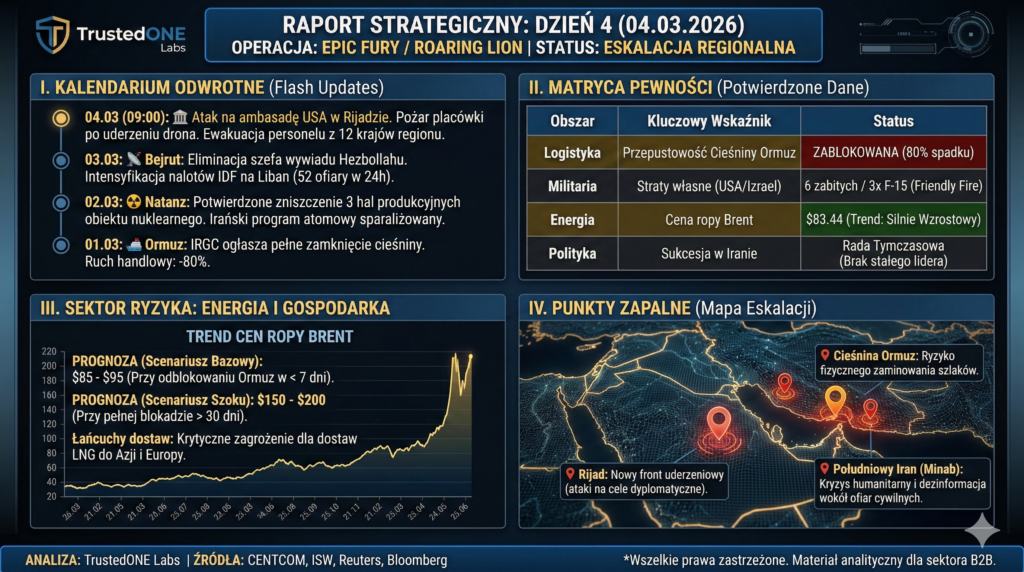
Operation “Epic Fury” has entered a critical phase. The attack on the U.S. Embassy in Riyadh and confirmed destruction in Natanz have shifted the conflict’s gravity from precision decapitation strikes toward full-scale regional destabilization.
On the fourth day of the war, the key takeaway is not U.S. military might, but information chaos. The occurrence of “friendly fire” incidents and a successful drone strike on the Riyadh facility suggests gaps in the regional air defense umbrella. For B2B enterprises, this signals one thing: prepare for long-term fuel and energy price volatility, regardless of the success of air operations.
1. Timeline of Events (Reverse Chronology)
Recent events indicate a rapid expansion of the theater of operations beyond Iranian territory.
March 4, 2026 (Status as of 09:00 CET):
Attack on Riyadh Embassy: An armed drone struck the U.S. diplomatic mission in Saudi Arabia. A fire was confirmed. This signals that Iran and its proxies are shifting the fight to the territory of Washington’s key regional ally. [^18][^25]
Mass Evacuation: The U.S. State Department has ordered the departure of diplomatic personnel from over 12 Middle Eastern countries, fearing a coordinated wave of retaliatory attacks. [^25]
March 3, 2026:
Rubio’s Warning: Secretary of State Marco Rubio announced “the heaviest blows are yet to come,” suggesting a transition to destroying Iran’s secondary civil-military infrastructure. [^39]
Lebanese Front: Escalation against Hezbollah. Israeli airstrikes in Beirut killed Hussein Mekeld (Hezbollah Intelligence Chief), among others. [^16][^26]
March 2, 2026:
Strike on Natanz: Satellite imagery confirmed severe damage to Iran’s main nuclear facility. At least 3 key buildings were destroyed. [^30][^5]
“Friendly Fire” Incident: CENTCOM confirmed the downing of 3 U.S. F-15s in Kuwait by mistaken allied fire. The crews survived. [^4]
March 1, 2026:
Official Succession: Tehran confirmed the death of Ali Khamenei. A temporary leadership council was formed under President Pezeshkian. [^22][^23]
Hormuz Blockade: The Iranian Revolutionary Guard (IRGC) announced the closure of the strait. Shipping traffic dropped by 80%. [^21]
February 28, 2026:
Operation Launch: Coordinated strike by the U.S. (“Epic Fury”) and Israel (“Roaring Lion”). Death of the IRGC top command and the Supreme Leader. [^16][^4]
2. Certainty Matrix – Analysis of Facts and Disinformation
The following table organizes the information chaos surrounding the fourth day of the war.
| Category | Hard Facts (Confirmed) | Disputed Claims / Discrepancies | Unknowns |
| Leadership | Death of Khamenei & Min. Nasirzadeh (Confirmed by Tehran). [^22] | Scale of factional infighting within the IRGC. [^43] | Who will assume permanent religious leadership in Iran? |
| Military | Destruction of at least 3 buildings in Natanz. [^30] | Scale of civilian casualties in Minab (Iran claims 180; U.S. has no data). [^19] | Location of hidden uranium stockpiles after strikes. |
| Economy | Brent price rise to $82; 80% drop in Hormuz traffic. [^33] | Is the Strait physically mined or just blocked by rhetoric? [^21] | Realistic timeline for restoring Gulf shipping. |
| U.S. Losses | 6 soldiers killed (CENTCOM). [^14] | Extent of damage to the Riyadh Embassy. [^25] | Possibility of transitioning to a ground operation. [^14] |
3. Strategic and Economic Scenarios
TrustedONE Labs identifies three primary paths for the conflict over the next 14 days.
3.1. Military Scenarios
| Scenario | Characteristics | Probability |
| Prolonged Air War | Continued airstrikes for 4-5 weeks focusing on missile launchers. [^14] | High (70%) |
| Regional Escalation | Full involvement of Hezbollah, Houthis, and Iraqi militias. Attacks on UAE infrastructure. [^39] | Rising (45%) |
| Ground Intervention | “Boots on the ground” to secure the coastline and Natanz. [^14] | Low (15%) |
3.2. Impact on Energy Prices (Brent Oil)
Analysts point to a direct correlation between the navigability of the Strait of Hormuz and global inflation.
Scenario A (Blockade < 7 days): Price stabilizes around $85-90/b.
Scenario B (Blockade 2-4 weeks): Spike to $110-130/b. Risk of recession in Europe. [^46]
Scenario C (Full Blockade > 1 month): Catastrophic scenario ($150-200/b). Global energy shock. [^46]
4. Official Government Positions
United States: Donald Trump describes the attacks as a “last best chance” to stop Iran’s nuclear program. Marco Rubio vows no mercy for the “terrorist regime.” [^14][^39]
Israel: Benjamin Netanyahu declares the goal is the total removal of the existential threat posed by the Ayatollahs. [^41]
Iran: Larijani rejects negotiations. The IRGC threatens to “burn every ship” that violates the Hormuz blockade. [^46][^16]
China and Russia: Official condemnation of the strikes; demands for a ceasefire, but no hard military action to support Tehran. [^35][^36]
Sources:
[^1], [^4], [^16] – CENTCOM / Reuters: Timeline of 2026 Strikes
[^5], [^30] – ISW: Special Report on Natanz Nuclear Site Hit
[^14], [^39] – CBS News / Marco Rubio Statement
[^21], [^42] – Reuters: Hormuz Strait Status and Shipping Threats
[^22], [^23] – Al Jazeera: Iran Succession Updates
[^33], [^46] – CNBC / Oil Prices and Scenarios Analysis
[^25] – U.S. State Department: Embassy Evacuation Orders
Related posts: