⚡ TL;DR: Key Changes Over the Last 24h
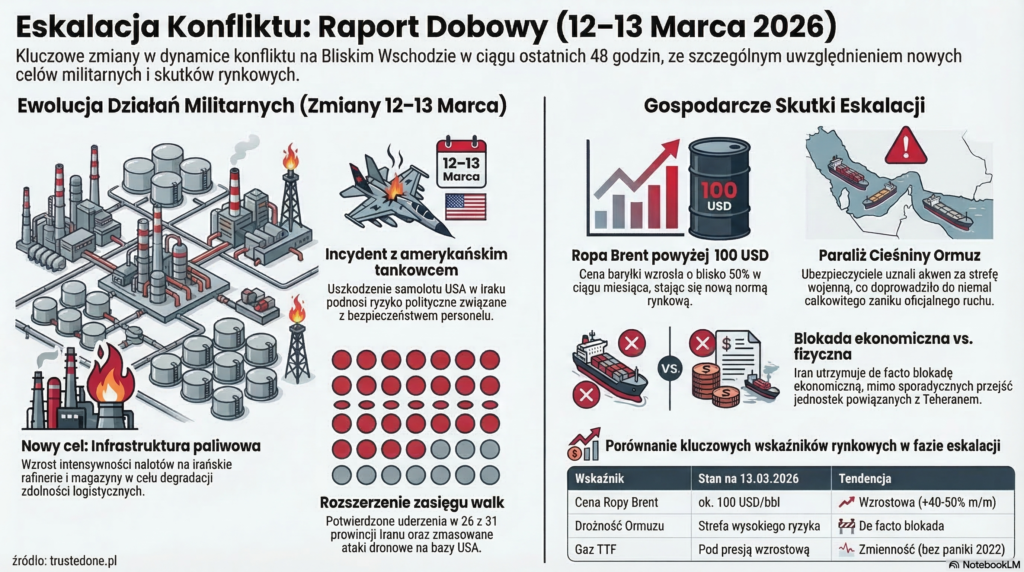
- Air Escalation: US and Israeli air operations have exceeded the two-week mark; strikes are now concentrating on logistics and fuel infrastructure.
- Incident in Iraq: Unconfirmed reports of damage to a US tanker aircraft; rescue operation is underway.
- Hormuz Crisis: The Strait is de facto a war zone. One auxiliary vessel sank following an attack.
- Energy Market: Brent crude remains around $100/bbl (+45–50% m/m). TTF gas is under upward pressure.
- Tehran’s Stance: Iran’s new Supreme Leader vows “resistance” and the maintenance of the economic blockade of Hormuz.
📝 Synthesis of Current Conflict Dynamics
The conflict has entered a phase of full-scale, high-intensity air and missile warfare. The US and Israeli strategy is evolving from destroying air defense (AD) systems toward the systematic degradation of Iran’s logistical backbone (refineries, fuel depots). Despite losses, Iran retains the capability to launch massive missile and drone volleys, effectively paralyzing commercial shipping in the Strait of Hormuz and exerting pressure on global energy markets.
📅 Timeline of Events (Last 48h)
| Time / Period | Event | Location |
|---|
| Last 24h | Massive airstrikes on logistical targets, refineries, and IRGC fuel depots. | Throughout Iran (especially the west and Tehran) |
| 12.03.2026 | Reported damage to a US tanker aircraft; rescue operation in progress. | Iraq |
| 12.03.2026 | Public declaration by Iran’s new leader regarding the continuation of the Hormuz blockade. | Tehran |
| Last 48h | Intensification of Hezbollah shelling in northern Israel; Houthi attacks in the Red Sea. | Israel / Red Sea |
| March 2026 | Series of attacks on tankers; sinking of one auxiliary vessel. | Strait of Hormuz |
⚖️ Information Certainty Matrix
| Confirmed Facts | Disputed Claims / Disinformation | Unknown Issues |
|---|
| Airstrikes in at least 26 out of 31 Iranian provinces. | Exact number of destroyed ballistic launchers (US claims “significant,” Iran downplays). | Real scale of Israeli special operations within nuclear facilities. |
| Brent crude around $100/bbl. | Effectiveness of Iranian volleys (conflicting data on interception rates). | Long-term endurance of Iran’s missile arsenal. |
| Official designation of Hormuz as a high-risk zone by insurers. | Number of civilian casualties (Iran reports >1300, no independent verification). | Precise US “red lines” regarding ground operations. |
🏛️ Official Government Positions
| Entity | Position / Statement |
|---|
| Iran | New Supreme Leader: Continuation of “resistance,” full control over Hormuz, no concessions under pressure. |
| USA / Israel | Continuation of the campaign to “degrade Iran’s military capabilities”; no specific timeframe provided. |
| Gulf States (KSA, UAE) | Calls for de-escalation; logistical preparations for long-term energy supply disruptions. |
| European Union | Fear of escalation; balancing condemnation of military actions with energy security concerns. |
💰 Economic and Social Dimension
Economy and Energy:
- Brent Crude: Approx. $100 per barrel. Increase of 45–50% over the month. The market is pricing in the risk of permanent disruptions in Hormuz.
- TTF Gas: Upward trend, though the dynamic is lower than during the 2022 crisis.
- Shipping: Hormuz has become a chokepoint with limited traffic. Insurers are dictating extreme war risk premiums. Some tankers (linked to Iran) are still sailing; others are avoiding the area.
Social and Humanitarian Situation:
- Iran: Over 1,300 civilian casualties (according to Tehran). Severe damage to energy infrastructure and public services. Reported internal unrest (difficult to verify).
- Israel / Lebanon: Massive evacuations from border areas due to intensified Hezbollah shelling. Population fatigue with the state of war.
🔮 Scenarious and Consequences
| Dimension | Current State (S2 – Regional War) | Short-term Outlook |
|---|
| Military | Air and missile war, proxy actions (Houthis, Hezbollah). | Risk of transitioning to S3 (limited ground raids) upon further escalation in Iraq/Kuwait. |
| Political | Consolidation of hardliners in Iran around the new leader. | Risk of nuclear proliferation in the region (e.g., Saudi Arabia) as a reaction to destabilization. |
| Economic | Oil price $90–110. | Entry into the $110–150 range if the Hormuz blockade persists for several more weeks. |
⚠️ Risk Matrix (What to Watch?)
| Element | Why It Matters |
|---|
| Incident with US Tanker | If casualties among US personnel are confirmed, political pressure for ground retaliation will increase. |
| Hormuz Traffic | A further decline in non-Iranian tanker passages will hit global growth and inflation (especially in the EU and Asia). |
| Energy Infrastructure | Strikes on refineries in Iran may force Tehran into even more desperate retaliatory steps. |
🔗 Full List of Sources
Related posts: