TL;DR: Key Changes in the Last 24h
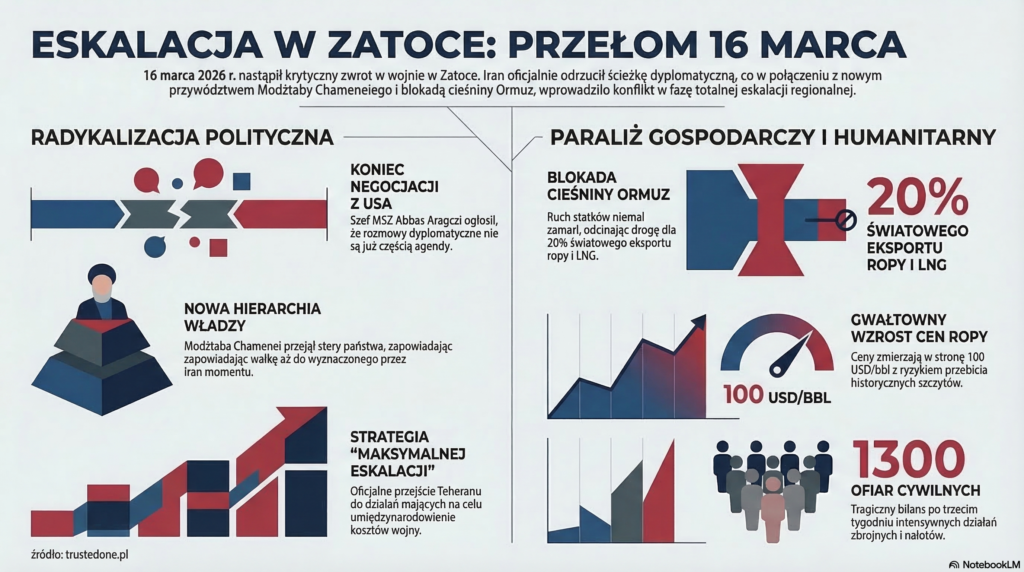
- Rejection of Negotiations: Iranian Foreign Minister Abbas Araghchi officially announced that talks with the US are “not on the agenda,” and Tehran is prepared for maximum escalation.
- Consolidation of Succession: Mojtaba Khamenei has taken the reins of the state, declaring that Iran will determine the moment the war ends.
- Hormuz Crisis: Shipping traffic through the strait has nearly come to a standstill; oil prices are surging amid fears of a prolonged blockade.
- Casualty Toll: The number of confirmed civilian casualties in Iran has exceeded 1,300 people.
Synthesis of Current Conflict Dynamics
The conflict has entered its third week of intense hostilities. Following the initial “decapitation” phase (the death of Ali Khamenei) and mass airstrikes under Operation “Epic Fury,” the war has transformed into a regional multi-front clash. The US and Israel aim for the total degradation of Iran’s missile and nuclear potential, while Tehran—utilizing the Islamic Revolutionary Guard Corps (IRGC) and its network of proxies (Hezbollah, Houthis)—is attempting to internationalize the costs of the conflict through an energy blockade and attacks on US bases in the Persian Gulf.
Timeline of Events (Reverse Chronology)
| Date / Period | Event | Description and Consequences |
|---|
| March 16, 2026 | Escalation Declaration | Abbas Araghchi (Iranian FM) rules out negotiations with the US; vows to fight “as long as necessary.” |
| March 10–16, 2026 | Third Week of War | Systematic US/Israeli strikes on Iranian infrastructure; Iranian retaliatory attacks on Gulf and Israeli targets. |
| March 8–9, 2026 | Khamenei’s Succession | Mojtaba Khamenei announced as the new Supreme Leader; declaration of continued resistance. |
| March 5–10, 2026 | Hormuz Blockade | Formal declaration of the strait’s blockade by Iran; rapid slowdown of tanker traffic. |
| March 1–4, 2026 | Iran’s Counterattack | IRGC strikes US bases (Bahrain, Kuwait, Qatar, UAE) and installations in Saudi Arabia with missiles. |
| Early March 2026 | Northern Front | Intensification of Hezbollah activities; first ground clashes of Israeli forces in southern Lebanon. |
| Feb 28, 2026 | Operation “Epic Fury” | 900 US/Israeli strikes in 12h. Death of Ali Khamenei following an airstrike. |
Information Certainty Matrix
| Certainty Level | Issues and Facts |
|---|
| Hard Facts (Confirmed) | Start of campaign on Feb 28; death of Ali Khamenei; nomination of Mojtaba Khamenei; missile attacks on US bases; Hezbollah participation; Hormuz blockade; oil price spike. |
| Disputed Claims (Conflicting Sources) | Scale of destruction of Iran’s missile arsenal (US: 80-90% vs. experts: mobile launchers survived); status of the nuclear program; scale of deliberate attacks on civilians. |
| Unknowns (Lack of Data) | Real influence of the IRGC on Mojtaba Khamenei; exact stockpiles of hidden uranium; ground invasion plans for Iran; actual depth of Russian and Chinese support. |
Official Government Positions
| Actor | Initial Position | Evolution and Current Line |
|---|
| IRAN | Shock after the leader’s death. | “Total war”; rejection of talks; economic pressure via Hormuz. |
| ISRAEL | Pre-emptive strike (existential). | Fight against the regime and IRGC, not the people; clearing southern Lebanon. |
| USA | Preventing attacks and defending allies. | Open suggestion of “regime change”; convoy escorts; protecting trade routes. |
| RUSSIA / CHINA | Criticism of “illegal use of force.” | Calls for a ceasefire; lack of open military engagement. |
Economic and Social Dimensions
Economy:
- Oil and Gas: Approximately 15-20% of global oil exports and 20% of LNG pass through Hormuz. Current price jump of 7%; Goldman Sachs and Rystad forecasts point to over $100/bbl, with the risk of breaking 2008 peaks.
- Supply Chains: The crisis hits East Asia (Japan, South Korea, India) hardest. Europe is feeling secondary inflation in production and transport costs (chemicals, automotive).
Society:
- Iran: Humanitarian crisis, destroyed critical infrastructure, hospital disruptions. Reports of brutal suppression of internal protests by the security apparatus.
- Region: Mass evacuations in northern Israel; constant missile alerts in Gulf countries.
- Migration: Growing refugee pressure from Iran, Lebanon, and Syria toward neighboring states and Europe.
Scenarios and Consequences
| Dimension | Optimistic Scenario (Limited) | Realistic Scenario (Regional) | Pessimistic Scenario (Total) |
|---|
| Military | Air-missile war; gradual exhaustion of arsenals. | Multi-front war (Lebanon, Syria, Iraq, Yemen). | Full-scale ground invasion; participation of third powers. |
| Political | Controlled transition under Mojtaba. | Consolidation of the regime around IRGC and war rhetoric. | Collapse of Iranian state structures; civil war. |
| Economic | Short-term disruptions; oil around $90-100. | Long-term Hormuz blockade; oil above $120; recession in Asia. | Global energy market collapse; hyperinflation of transport costs. |
Risk Matrix: What to Watch?
| Factor | Why it Matters? | Warning Indicator |
|---|
| Strait of Hormuz | Key to the global economy. | Attempts to forcefully break the blockade by the US Navy. |
| Nuclear Program | Possible “breakout” attempt (building a bomb). | Movements in hidden underground installations. |
| Russian Role | May provide Iran with air defense systems or intel. | Increased number of cargo flights between Moscow and Tehran. |
| Saudi Stability | Attacks on Aramco facilities could shut down millions of bpd. | Effectiveness of Patriot/THAAD systems in defending oil fields. |
List of Sources
Related posts: