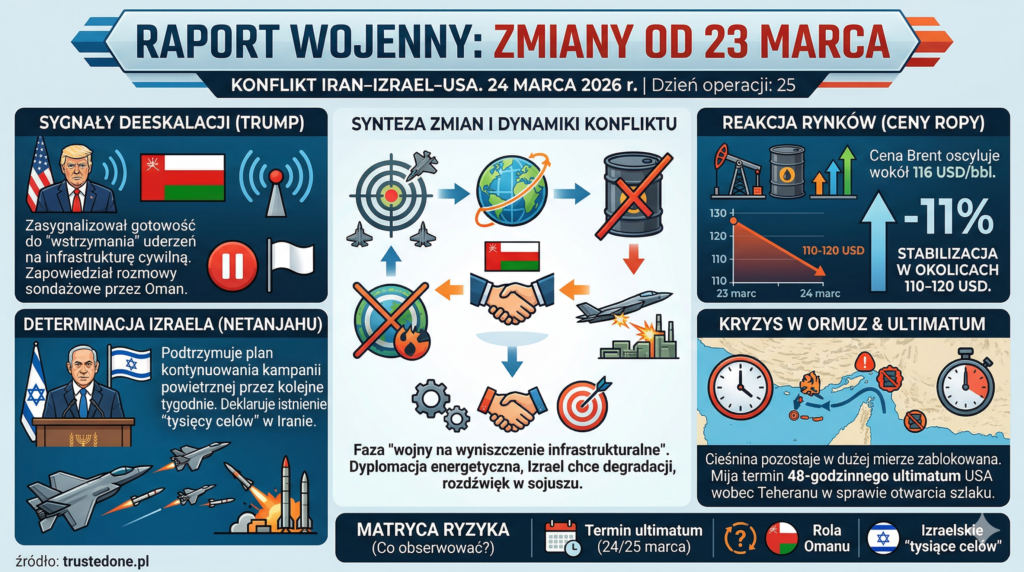
TL;DR: Key Changes in the Last 24h
- De-escalation Signals: Donald Trump has signaled readiness to “pause” strikes on civilian infrastructure and announced exploratory talks through Oman.
- Market Reaction: Brent crude prices saw a sharp 11% drop following the White House statements, stabilizing around $110–120 USD.
- Israel’s Determination: Prime Minister Netanyahu maintains the plan to continue the air campaign for several more weeks, declaring the existence of “thousands of targets” in Iran.
- Hormuz Crisis: The strait remains largely blocked; the 48-hour US ultimatum to Tehran regarding the opening of the shipping route is expiring.
Synthesis of Changes and Conflict Dynamics
The conflict has entered a phase of “infrastructure war of attrition” combined with intense energy diplomacy. Following the first phase (strikes on command structures and the death of Ali Khamenei), the center of gravity has shifted to global energy supply chains. While signals from Washington regarding a possible “pause” offer hope for de-escalation, Israel remains focused on the maximum degradation of Iran’s missile and nuclear potential, creating a rift within the allied camp.
Conflict Timeline (Reverse Chronology)
| Date | Event | Description and Consequences |
|---|
| March 23/24 | De-escalation Signals | Trump announces readiness for talks via Oman. Oil prices drop by 11%. |
| March 22 | Trump’s Ultimatum | A 48-hour deadline to open the Strait of Hormuz under threat of destroying civilian power plants in Iran. |
| March 18 | Energy War | Israel attacks the South Pars field. Iran responds with strikes on Ras Laffan (Qatar) and Yanbu (Saudi Arabia). |
| March 13 | Battle for the Islands | US strikes Iranian military installations on islands near the Strait of Hormuz. Threat of strike on the Kharg terminal. |
| March 11 | UNSC Resolution | Adoption of Resolution 2817 calling on Iran to cease attacks (Russia and China abstain). |
| March 6 | Tragedy in Minab | Strike on a girls’ school. Over 100 casualties. Analysis indicates use of US precision-guided munitions. |
| March 4 | Hormuz Blockade | Official announcement by Iran of “closing” the strait to shipping from hostile nations. |
| March 1 | Death Confirmation | Iranian state television confirms the death of Ali Khamenei. 40-day mourning period announced. |
| Feb 28 | Day 1: The Strike | Coordinated US and Israeli campaign against AD systems and IRGC bases in 26 Iranian provinces. |
Information Certainty Matrix
| Category | Confirmed Facts | Disputed Claims / Misinformation | Unknowns |
|---|
| Politics | Death of Ali Khamenei; UNSC Resolution 2817. | Level of support for IRGC after leader’s death; intentionality of the Minab school strike. | Who actually holds power in Tehran; Khamenei’s ultimate successor. |
| Military | Strikes on South Pars and Ras Laffan; use of precision munitions in 26 provinces. | Degree of nuclear program degradation (US claims “high”, experts “moderate”). | Scale of hidden uranium stockpiles; location of mobile missile launchers. |
| Society | Death of students in Minab; mass protests in 2025-26. | Protest death toll (Govt: 3k, NGOs: 6-10k and more). | Fate of missing oppositionists; scale of internal migration in Iran. |
Official Government Positions
| Country | Position / Objectives | Evolution of Message |
|---|
| USA (Trump) | Elimination of nuclear threat, freedom of navigation. | From “maximum strike” to proposing a “pause” and negotiations under fuel price pressure. |
| Israel | Total destruction of Iran’s missile and nuclear potential. | Hardening of rhetoric; open suggestion of supporting regime change (“Iranians will shape the future”). |
| Iran | Defense of sovereignty against “aggression,” retaliation on infrastructure of US allies. | From threats of total war to using the Hormuz blockade as a primary bargaining chip. |
| Russia / China | Criticism of “illegal” strikes, calling for restraint. | Shift from silence to abstention at the UN; no direct military intervention. |
Economic and Social Dimensions
Economy (Energy and Market)
- Crude Oil: Brent prices fluctuate around $116 USD/bbl, with temporary drops to $110 USD following diplomatic signals. A full blockade of Hormuz could drive prices to $150+ USD.
- Natural Gas: The attack on Ras Laffan in Qatar knocked out approximately 20% of global LNG supply, causing a twofold increase in prices at the European TTF hub since the conflict began.
- Inflation: Sharp rise in maritime transport costs hits Asia (China, Japan) and Europe, threatening a global recession.
Social and Humanitarian Situation
- Civilian Casualties: Iran claims 1,332 civilians killed in airstrikes. The girls’ school in Minab remains the most tragic symbol.
- Internal Repression: Leveraging the state of war, the IRGC is suppressing the remains of the opposition. Estimates of internal clash casualties from late 2025/26 reach 6,000 people.
- Migration: The UN reports increasing numbers of refugees at the borders with Turkey and Iraq, though systemic border closures hinder mass escapes.
Scenarios and Consequences
| Area | Probable Scenario (Pause) | Escalation Scenario (Total War) |
|---|
| Military | Stabilization of the air front, limited special raids, attempt to unblock Hormuz by force. | Full-scale ground invasion of oil terminals, activation of all Hezbollah cells. |
| Political | Power takeover by the “hardline core” of the IRGC, facade negotiations. | Complete collapse of Iranian state structures, civil war, loss of control over nuclear assets. |
| Economic | Oil in the $100-120 range, slow recovery of LNG supply chains. | Oil above $180, global economic depression, energy rationing in Europe. |
Risk Matrix (What to Observe?)
- Ultimatum Deadline (March 24/25): If Iran does not open Hormuz, will Trump follow through on the threat to attack Iranian civilian power plants?
- Role of Oman: Will the diplomatic channel prove effective, or is it merely a stalling tactic for both sides?
- Israel’s “Thousands of Targets”: Will Israel strike nuclear facilities (e.g., Natanz, Fordow) independently, ignoring the American “pause”?
Full List of Sources
Related posts: